
You may have been working toward Social Security disability insurance coverage for years without even realizing it.
The date your disability insurance coverage begins is known as your Date First Insured (DFI). In simple terms, it marks the date when you've earned enough work credits within the required time periods to qualify for Social Security Disability Insurance (SSDI) coverage.
Most people don't hear about their DFI until they start looking into disability benefits. Understanding this date can be especially helpful if you've had health problems for a long time, taken time away from the workforce, or spent years working while managing a disability or chronic illness.
How Is Your Date First Insured Determined?
Unlike many other types of insurance, you don't need to sign up separately for SSDI coverage. As you work in employment or self-employment covered by Social Security, you earn work credits.
Think of your work credits as the key that opens your window of SSDI insurance coverage. You need to earn enough credits, within the required time periods, before that window can open.
But why does your coverage begin on a particular date?
Social Security divides each year into four three-month periods called calendar quarters. Your Date First Insured (DFI) is the first day of the quarter in which you first meet the insurance requirements.
That means your DFI will fall on one of these four dates:
January 1
April 1
July 1
October 1
For example, if April through June is the first quarter in which you qualify for coverage, your DFI is April 1.
Your DFI isn't necessarily the day you started working or even the day you received the paycheck that helped you earn the last work credit you needed.
How many credits you need and when you need to have earned them depend on several factors, including your age and work history. Younger workers may qualify with fewer credits, and different requirements apply to people who meet Social Security's definition of statutory blindness.
If you're unfamiliar with work credits, you may find these articles helpful:
Understanding Your DFI and DLI
Think of your SSDI insurance coverage as a window of time. Your Date First Insured (DFI) marks the day that window opens, and your Date Last Insured (DLI) marks the last day you're insured before that window closes.
When you apply for SSDI, Social Security looks at when your disability began and when you were insured. The illustration below shows how your window of coverage begins and ends.
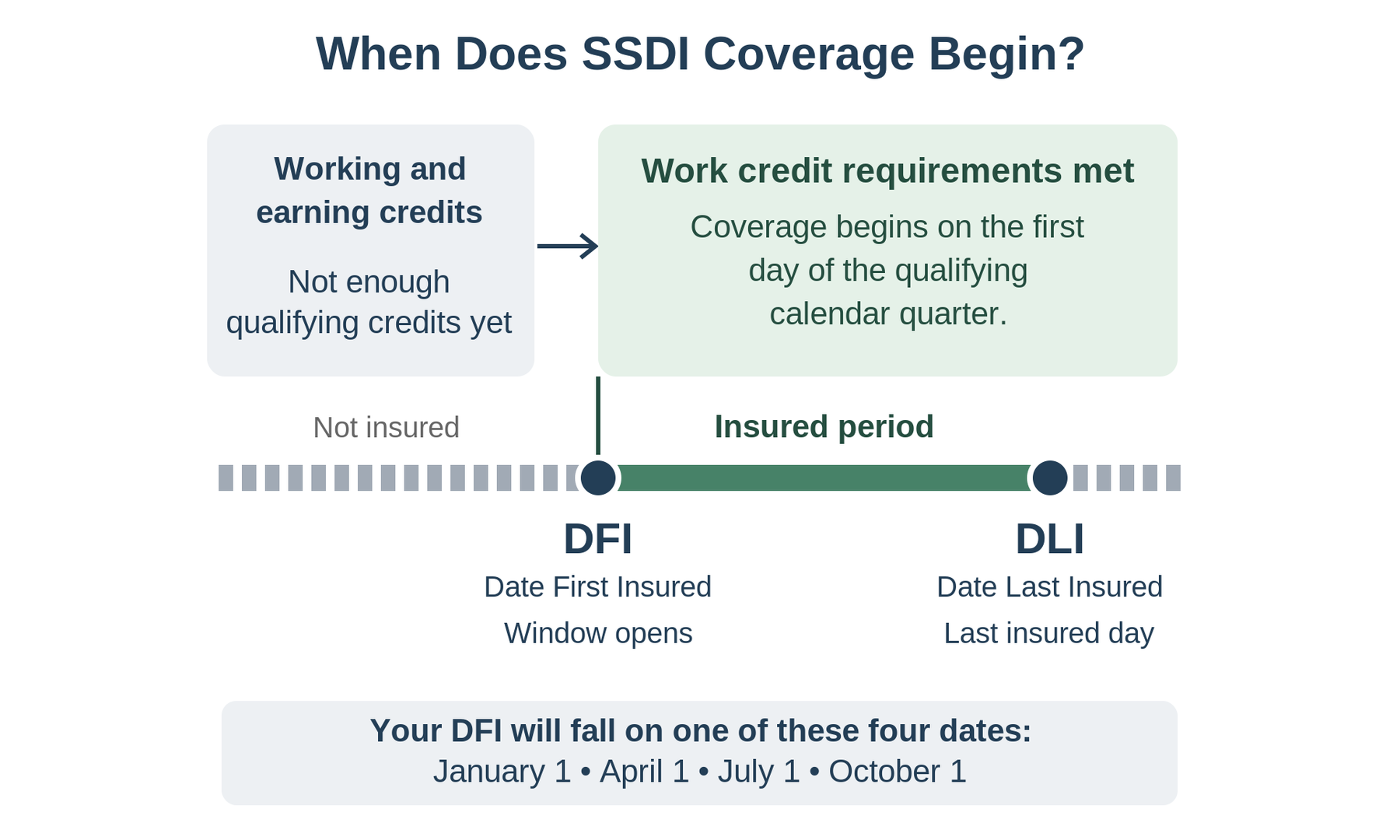
Your window of SSDI coverage can change throughout your working life. You may maintain your coverage for many years, or you may lose it and regain it later. Each separate period of coverage has its own Date First Insured and Date Last Insured.
Can You Have More Than One Date First Insured?
Yes. You may have more than one period of disability insurance coverage during your working life.
Perhaps you took several years off to raise children, care for an aging parent, return to school, or deal with your own health problems.
Depending on your earnings history, your SSDI insurance coverage may have expired during that time.
If you later return to work and meet the applicable work credit requirements again, a new window of coverage may open, with a new Date First Insured.
This is one reason why knowing the total number of work credits you've earned doesn't necessarily tell you whether you were insured on a particular date.
But what happens if your disability begins before your window of insurance coverage opens? Can you still qualify for SSDI?
What If Your Disability Began Before You Became Insured?
Life doesn't always follow Social Security's calendar.
Perhaps you were born with a medical condition, developed a chronic illness as a teenager, or experienced a serious injury early in your working life.
You may wonder whether you can qualify for SSDI if your medical condition existed before you earned enough work credits to become insured.
The answer is yes, potentially.
SSDI doesn't automatically exclude you because you have a preexisting medical condition.
There's also an important difference between the date you developed a medical condition and the date that condition became disabling under Social Security's rules.
But what if your condition was already disabling under those rules before your insurance coverage began?
You may still qualify if you meet Social Security's disability requirements when you become insured and satisfy the other eligibility requirements.
Let's Look at an Example
Imagine Maria has been living with a progressive neurological condition for several years. She's been working, but her symptoms have gradually become more difficult to manage.
On February 15, her condition becomes severe enough to prevent her from engaging in what Social Security calls substantial gainful activity (SGA).
Based on her earnings record, Social Security determines that her Date First Insured is April 1.
Maria's medical condition became disabling before her insurance coverage began.
If Maria continues to meet Social Security's disability requirements on April 1 and meets the other applicable requirements for establishing disability, Social Security may establish April 1 as her official SSDI disability onset date.
What about those weeks between February 15 and April 1?
Although Social Security cannot establish Maria's official SSDI onset date before her Date First Insured, it can consider that earlier period when determining whether her disability meets the 12-month duration requirement.
Social Security generally requires that your disability prevents you from performing substantial gainful activity for at least 12 consecutive months, is expected to prevent you from doing so for that long, or is expected to result in death.
Maria's example illustrates why medical records from before your Date First Insured may still be important.
How Your Date First Insured Fits Into Your SSDI Application
When you apply for SSDI, you'll be asked when your disability began preventing you from working. This is one of the questions you'll encounter on Form SSA-16, Application for Disability Insurance Benefits.
As Social Security reviews your application, you may encounter several dates and abbreviations.
Here's a quick guide to what they mean:
Date First Insured (DFI): The first day of a period of disability insurance coverage.
Date Last Insured (DLI): The last day of that insurance coverage period.
Alleged Onset Date (AOD): The date you report that your disability began.
Potential Onset Date (POD): The earliest date Social Security identifies as a possible official onset date based on applicable nonmedical requirements.
Established Onset Date (EOD): The official disability onset date Social Security determines based on the applicable medical and nonmedical requirements.
These dates aren't always the same.
If you believe your disability began before your Date First Insured, that doesn't mean you need to change the date you report on your application simply to match your insurance coverage.
Social Security considers your medical records, earnings history, work activity, and other relevant information when determining your official onset date.
Curious about how different onset dates might affect your benefits? Try our free SSDI Onset Date Comparison Calculator to explore how these dates may affect your eligibility, potential back pay, and Medicare coverage.
The calculator is an educational tool and cannot determine your official insured status or disability onset date.
How Can You Find Your Date First Insured?
You can contact Social Security at 1-800-772-1213 and ask for your Date First Insured and Date Last Insured.
If you've had lengthy gaps in employment, you may also want to ask whether you've had more than one period of disability insurance coverage.
You can review your reported earnings through your my Social Security account.
While you're there, take a look at your earnings history. If you notice missing or incorrect earnings, you can contact Social Security about correcting your record.
Your earnings history is a helpful starting point, but Social Security determines your official insured status.
A Date Worth Knowing
Your work history and medical history each tell a different part of your story. When you apply for SSDI, Social Security considers how those two histories fit together.
Knowing when your disability insurance coverage began and when it ends can help you better understand that process, particularly if you've experienced health problems throughout your working life.
And remember, having a medical condition before you became insured doesn't automatically disqualify you from receiving SSDI.
Frequently Asked Questions
Q. Is my Date First Insured the same as the date I earned my first Social Security work credit?
A. No. Earning your first work credit is a step toward becoming insured, but you must meet all applicable insured-status requirements before your disability insurance coverage begins.
Source: 20 C.F.R. § 404.130.
Q. Do I have to be disabled for 12 months after my Date First Insured to qualify for SSDI?
A. No. Social Security can consider periods of disability before your Date First Insured when evaluating the duration requirement. You also don't have to wait until you've been disabled for 12 months to apply if your disability is expected to last that long or result in death.
Sources: POMS DI 25501.310 and 20 C.F.R. § 404.1505.
Q. Does my Date First Insured affect when my SSDI benefits can begin?
A. Yes. Your Date First Insured can affect your official disability onset date and when your waiting period begins, if one is required. The date you apply and other eligibility requirements can also affect when you become entitled to benefits.
Source: 20 C.F.R. § 404.315.
References
Federal statutes and regulations
Social Security Act § 223, 42 U.S.C. § 423. Disability insurance benefit payments.
https://www.ssa.gov/OP_Home/ssact/title02/0223.htm
20 C.F.R. § 404.130. How we determine disability insured status.
https://www.ssa.gov/OP_Home/cfr20/404/404-0130.htm
20 C.F.R. § 404.131. When you must have disability insured status.
https://www.ssa.gov/OP_Home/cfr20/404/404-0131.htm
20 C.F.R. § 404.315. Who is entitled to disability benefits.
https://www.ssa.gov/OP_Home/cfr20/404/404-0315.htm
20 C.F.R. § 404.1505. Basic definition of disability.
https://www.ssa.gov/OP_Home/cfr20/404/404-1505.htm
Social Security rulings and administrative guidance
Social Security Administration. (2018). SSR 18-01p: Titles II and XVI: Determining the established onset date (EOD) in disability claims.
https://www.ssa.gov/OP_Home/rulings/di/01/SSR2018-01-di-01.html
Social Security Administration. (2024). POMS DI 25501.310: The established onset date (EOD) for disability insurance benefit (DIB) claims and date first insured (DFI).
https://secure.ssa.gov/poms.nsf/lnx/0425501310
Social Security Administration. (2023). POMS DI 25501.220: Potential onset date (POD).
https://secure.ssa.gov/poms.nsf/lnx/0425501220
Disclaimer
Disclaimer: This article is for informational purposes only and does not constitute medical or legal advice. Consult with a qualified healthcare provider for any medical concerns or questions. Consult with a licensed attorney for legal advice.
AI Ethical Statement
AI Ethical Statement: This article includes information sourced from government and reputable health websites, reputable academic journals, non-profit organizations, and generated with help from AI. A human author has substantially edited, arranged, and reviewed all content, exercising creative control over the final output. People and machines make mistakes. Please contact us if you see a correction that needs to be made.
