
What Is a DDS Medical Consultant?
Understanding the Doctor Who Reviews Medical Evidence in an SSDI Claim
Some of the most important doctors in an SSDI claim may never sit across from you in an exam room.
A DDS medical consultant is a licensed physician who reviews medical evidence for Disability Determination Services, often called DDS. For mental health conditions, DDS may use a psychological consultant, who is a licensed psychologist. These consultants help DDS evaluate medical evidence under Social Security Administration rules.
Most applicants never speak with a DDS medical consultant directly. Even so, these reviewers may help shape how DDS understands the medical evidence in a disability file. DDS medical consultants usually work behind the scenes rather than speaking with applicants personally, which is one reason the SSDI process can sometimes feel confusing or difficult to follow.
What the DDS Does — and Where Medical Consultants Fit In
After someone applies for SSDI, the claim often starts at a local Social Security office, where non-medical issues such as work history and technical eligibility may be reviewed first. The medical portion of the claim is then usually sent to Disability Determination Services, commonly called DDS. DDS is the state agency that works with the Social Security Administration to evaluate disability claims.
Within DDS, two different professionals often work on the same case, but their jobs are not the same.
DDS Disability Examiners
DDS disability examiners are generally claims specialists rather than doctors. They help develop the claim by requesting medical records, tracking evidence, contacting healthcare providers, and arranging consultative examinations if additional information is needed.
DDS Medical Consultants and Psychological Consultants
DDS medical consultants are licensed physicians who review the medical evidence collected in the file. For mental health claims, DDS may use psychological consultants, who are licensed psychologists.
These consultants provide medical findings to the DDS disability examiner about issues such as diagnosis, severity, functional limitations, and whether the medical evidence is sufficient for DDS to complete its review.
DDS medical consultants are usually licensed M.D.s or D.O.s who work for, or under contract with, a state DDS office. Many have backgrounds in areas such as internal medicine, family medicine, orthopedics, neurology, cardiology, psychiatry, or psychology.
Their role is also different from the role of a treating doctor. A treating doctor focuses on patient care and ongoing treatment. A DDS medical consultant focuses on reviewing medical evidence under SSA disability standards.
What DDS Medical Consultants Review
A DDS medical consultant reviews medical evidence in the claim file. Consultants generally review the entire medical picture rather than focusing on only one diagnosis. That may include multiple conditions, medications, treatment history, test results, and how different impairments affect daily functioning. This may include:
Doctor and specialist records
Hospital records
Imaging reports
Lab results
Medication history
Mental health treatment records
Consultative examination reports
Information about daily activities and functional limitations
The consultant does not treat patients, prescribe medication, or manage ongoing care. Instead, the consultant reviews the records already collected and helps DDS interpret what the medical evidence shows about work-related limitations.
When the evidence appears inconsistent, the DDS medical consultant may need to explain how the medical findings were evaluated. For example, the consultant may compare treatment notes, test results, consultative examination findings, and statements about daily activities. The goal is not to second-guess an applicant’s experience, but to help DDS understand how the available evidence fits together under SSA disability rules.
Because DDS medical consultants rely heavily on the records contained in the file, updated medical records and ongoing treatment documentation may help DDS complete a more accurate review of functional limitations.
Do DDS Medical Consultants Decide SSDI Claims?
DDS medical consultants do not usually approve or deny SSDI claims by themselves.
Under SSA policy, the disability examiner, medical consultant, and psychological consultant may work together as an adjudicative team. The medical consultant provides medical findings. The disability examiner uses the evidence in the file, along with SSA rules, to help complete the disability determination.
In practical terms, the DDS medical consultant reviews the medical side of the claim, while the overall disability determination follows SSA rules and procedures.
What Is Residual Functional Capacity?
Residual Functional Capacity, often shortened to RFC, means what a person may still be able to do in a work setting despite medical limitations.
For example, SSA may consider whether a person can sit, stand, walk, lift, remember instructions, stay focused, interact with others, or complete tasks during a workday.
DDS medical consultants may provide medical findings used in the RFC assessment. Physical RFC findings may be documented on Form SSA-4734-BK, while mental RFC findings may appear on Form SSA-4734-SUP.
Form SSA-4734-BK is commonly called the Physical Residual Functional Capacity Assessment. DDS medical consultants may use this form to record medical findings about physical work-related limitations, such as sitting, standing, walking, lifting, carrying, pushing, or pulling. The form is used within DDS as part of the disability evaluation process. It is different from a consultative examination report, which is created by a separate doctor or psychologist who performs a one-time exam requested by DDS. You can read our article “Confused about RFC reports? How SSA-3373, SSA-4734, and the RFC assessment work together” to learn more about the different RFC-related forms.
RFC focuses on functional ability rather than diagnosis alone. Two people with the same condition may still have very different physical or mental limitations in a work setting.
Do DDS Medical Consultants Examine Applicants?
Usually, no.
DDS medical consultants generally review the records in the file. They do not normally meet the applicant, perform a physical exam, or provide treatment.
If DDS needs more information, the disability examiner may arrange a consultative examination with a separate doctor or psychologist. That consultative examiner performs the exam and sends a report to DDS. The DDS medical consultant may later review that report along with the rest of the file.
In short: the DDS medical consultant interprets medical evidence. They usually do not create new treatment records.
How DDS Medical Consultants Differ from Other Doctors
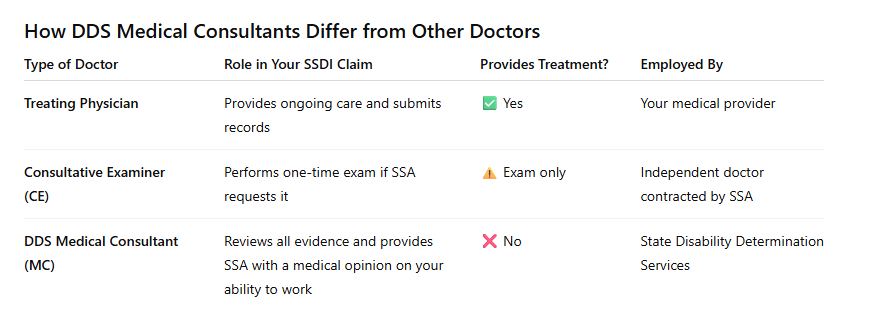
Medical doctors have different roles in SSDI claims
Why the DDS Medical Consultant Matters
DDS medical consultants help DDS evaluate how medical conditions may affect a person’s ability to function in a work setting. Their role is meant to provide medical review within the disability evaluation process.
DDS medical consultants are also expected to follow SSA regulations, medical criteria, and agency policy when reviewing claims rather than relying on personal opinions or preferences.
Their findings may be used when DDS considers:
The severity of a medical condition
Whether an impairment meets or equals an SSA listing
Physical or mental functional limitations
RFC findings
Whether more medical evidence is needed
This does not mean the consultant controls the outcome of a claim. It means their medical review is one part of the evidence-based process SSA uses to evaluate disability claims.
A 2026 Note About DDS Workloads
In March 2026, SSA announced that it would bring medical continuing disability reviews in-house so DDS offices could focus more on initial disability claims and reconsideration cases. That update does not change the basic definition of a DDS medical consultant, but it may affect how DDS offices manage workloads over time.
For applicants, the most important takeaway is still the same: DDS medical consultants review medical evidence as part of the disability determination process.
Summary
A DDS medical consultant is a licensed physician who reviews medical evidence for a state Disability Determination Services office during the SSDI process. For mental health claims, a licensed psychological consultant may review the mental health evidence.
These consultants do not usually examine applicants or provide treatment. Instead, they review the medical file, help evaluate functional limitations, and provide medical findings used by DDS under SSA rules. This combined information is considered when evaluating a claim for disability.
Understanding this role can make the SSDI process feel a little less hidden and a little easier to follow.
FAQ
Q: Are DDS medical consultants real doctors?
A: Yes. They are licensed physicians (or psychologists for mental health claims) who review evidence for the state DDS under federal standards.
(Source: SSA POMS DI 24501.001, https://secure.ssa.gov/poms.nsf/lnx/0424501001)
Q: Do they ever meet or examine claimants?
A: No. DDS medical consultants review your records only. If more information is needed, the DDS may schedule a separate consultative exam with an independent doctor.
(Source: SSA POMS DI 22510.005, https://secure.ssa.gov/poms.nsf/lnx/0422510005)
Q: Do DDS consultants look at what I wrote on Form SSA-3373?
A: Yes. They consider your Adult Function Report (Form SSA-3373) and compare it with your medical records. If there are conflicts, they explain those differences in their RFC report.
(Source: SSA POMS DI 24510.005, https://secure.ssa.gov/poms.nsf/lnx/0424510005)
References
Social Security Administration. (n.d.). Disability Determination Process. https://www.ssa.gov/disability/determination.htm
Social Security Administration. (2024). DI 24501.001 – The Disability Determination Services Disability Examiner, Medical Consultant, and Psychological Consultant Team, and the Role of the Medical Advisor. https://secure.ssa.gov/apps10/poms.nsf/lnx/0424501001
Social Security Administration. (2026). Social Security Administration Brings Medical Continuing Disability Reviews In-House. https://www.ssa.gov/news/en/press/releases/2026-03-12.html
Social Security Administration. (n.d.). POMS DI 24510.005 – Evaluating Residual Functional Capacity (RFC).https://secure.ssa.gov/poms.nsf/lnx/0424510005
Social Security Administration. (n.d.). POMS DI 22510.005 – Overview of the Consultative Examination Process.https://secure.ssa.gov/poms.nsf/lnx/0422510005
Indiana Department of Administration. (2018). SSA-4734-BK: Physical Residual Functional Capacity Assessment (Attachment J) [PDF]. https://www.in.gov/idoa/proc/bids/rfp-18-075/075attj.pdf
Disclaimer: This article is for informational purposes only and does not constitute medical or legal advice. Consult with a qualified healthcare provider for any medical concerns or questions. Consult with a licensed attorney for legal advice.
AI Ethical Statement: This article includes information sourced from government and reputable health websites, reputable academic journals, non-profit organizations, and was generated with help from AI. A human author has substantially edited, arranged, and reviewed all content, exercising creative control over the final output. People and machines make mistakes. Please contact us if you see a correction that needs to be made.
